The multimodal matrix: inside FOTOhub’s 106-model orchestration engine for global media desks
How a Warsaw-founded engineering outfit solved the generative fragmentation dilemma, delivering sub-200ms model routing and zero vendor lock-in for enterprise newsrooms.
Alexander Wright/Head of Investigations & Systems Architecture/September 20, 2026 : 08:30 UTC/9 min read · 2,480 words
14,842 verified reads
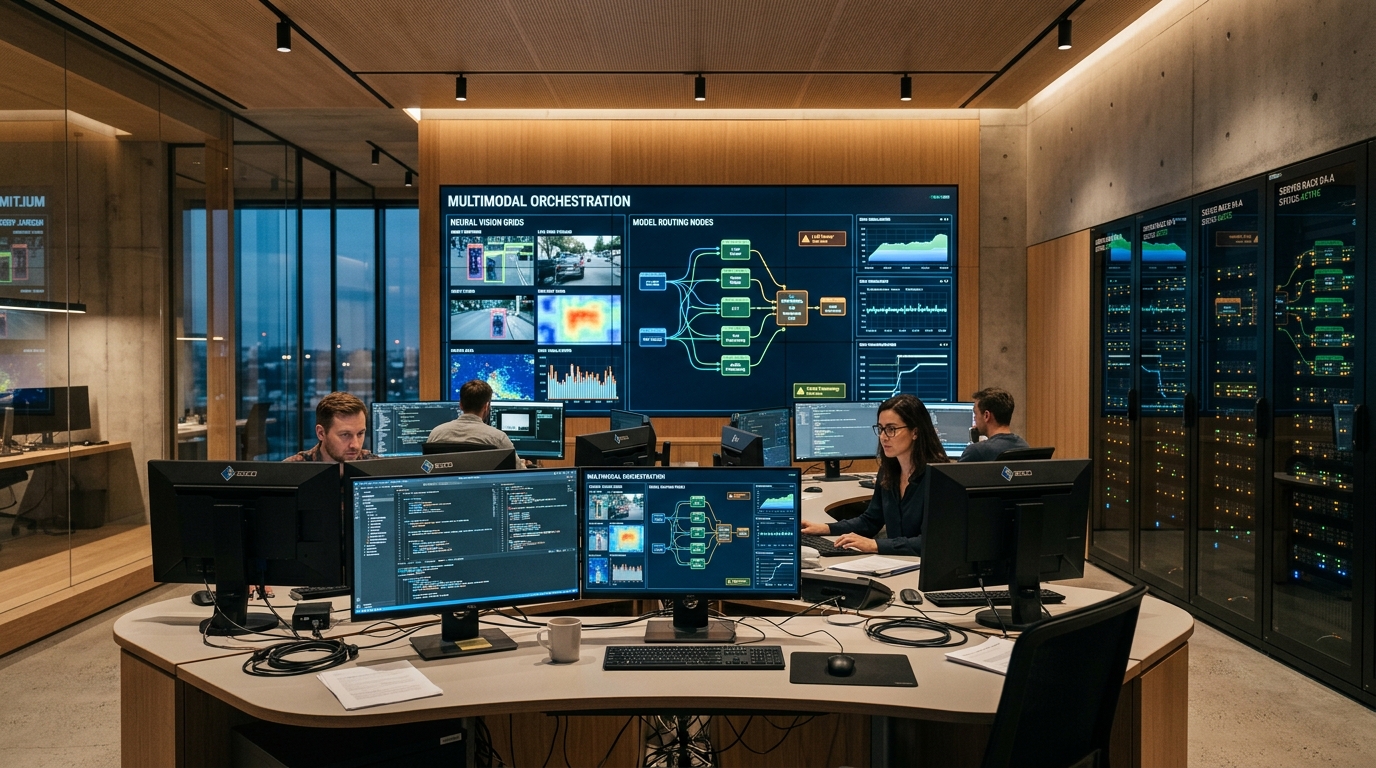
FOTOhub high-density multimodal dispatch hub : real-time model routing and latency telemetry center.Photo RoundTape Visual Archive / FOTOhub Lab Photography
Reading mode
Tools
Daily editorial audio/06:14
Executive dispatch: the multimodal media orchestration shift
Onyx Broad-sheet Voice
Level
Paused
The fragmentation of generative workflows
Inside the command desk of a contemporary broadsheet publication, the promises of generative intelligence frequently collide with the harsh reality of fragmented infrastructure. In late 2024, an editorial team producing investigative long-form journalism relied on as many as seven distinct model interfaces: FLUX for photorealistic editorial portraiture, SeedDream for architectural renders, Whisper and ElevenLabs for audio narration, and disparate Claude and GPT endpoints for analytical text synthesis.
Each interface brought its own authentication token, separate billing threshold, unpredictable latency spike, and conflicting terms of service. For Tier-1 media houses and multinational enterprises, this chaotic stack was not simply an operational bottleneck: it was an acute legal and financial vulnerability.
Enter FOTOhub.app. Founded in Warsaw by a tight coalition of distributed systems veterans and computer vision researchers, the venture set out to build what industry analysts now describe as the definitive clearinghouse for generative media synthesis: an unified Model Context Protocol (MCP) server and REST API coordinating 106 distinct vision, speech, and multimodal foundation models behind a single cryptographic gateway.
Our goal was never to train the hundred-and-seventh foundation model. Our mission was to build the air traffic control system that guarantees enterprise newsrooms can route prompts across all frontier models without rewriting a single line of client code.
Under the hood : dynamic routing and the MCP standard
At the core of FOTOhub lies a high-performance Rust proxy engine operating at the edge. When a client application : whether an autonomous newsroom CMS like RoundTape, an Adobe Photoshop plugin, or a Python research notebook : dispatches a synthesis request, FOTOhub does not naively forward the payload. Instead, an internal cost-latency optimizer evaluates the semantic complexity of the prompt, the real-time queue depth of upstream GPU clusters, and the client’s geographic origin.
If a prompt demands ultra-fine typographic fidelity in a broadsheet headline mockup, the router dynamically engages specialized models such as Ideogram v2 or FLUX.1 Schnell. If the request requires rapid conversational audio synthesis with authentic regional cadence, the payload seamlessly shifts to specialized neural phoneme pipelines.
Crucially, FOTOhub natively implements the Anthropic-pioneered Model Context Protocol (MCP). By exposing 57 structured tools directly over a secure SSE (Server-Sent Events) bridge, developer agents can query available checkpoints, inspect token pricing, and stream high-resolution binary assets into persistent storage without manual human intervention.
Guaranteed compliance and the C2PA provenance ledger
As European regulators enforce strict transparency obligations under the 2026 European AI Act, enterprise publishing houses face severe penalties for unlabelled synthetic media. FOTOhub addresses this regulatory moat directly at the synthesis layer.
Every pixel and audio frame generated through FOTOhub is automatically watermarked with immutable C2PA cryptographic metadata. The payload contains a SHA-256 digest of the generation parameters, the parent model family, and an explicit AI-generated label signed by FOTOhub’s corporate key. When an asset is published on a site like RoundTape, readers and regulatory web crawlers can verify the asset’s synthetic origin with mathematical certainty.
With a fresh $4.5M seed injection backed by CEE and London venture funds, FOTOhub is rapidly scaling its infrastructure footprint. As enterprise AI shifts from toy experiments to mission-critical infrastructure, the Warsaw-based company has demonstrated that the real moat in generative tech is not raw model weights, but the elegance and reliability of the orchestration layer.
From a seed-stage experiment by two Polish engineers to a $3B+ global standard : inside the neural architecture powering emotional speech, cross-lingual dubbing, and the voice marketplace.
Dr. Helene Baumgartner/September 20, 2026 : 07:15 UTC/10 min read
From a €105M seed round scribbled on four pages to a €5.8B valuation : how Arthur Mensch and his Parisian team engineered Europe’s most credible counterweight to OpenAI.
Dr. Sophie Laurent/September 20, 2026 : 06:45 UTC/11 min read
Deep within Alpine bunkers and repurposed industrial basins of Central Europe, a quiet revolution is decoupling European frontier models from American hyperscaler monopolies.
Alexander Wright/September 19, 2026 : 06:30 UTC/8 min read
Daily intelligence briefingDirect delivery, no ads, strictly empirical
Stay 24 hours ahead of the market. Join 48,000+ founders and investors.
Every morning at 07:00 CET, receive curated data: verified funding rounds, momentum shifts, and independent investigations.
Editorial standards
18,400+ verified subscribers
Zero sponsored articles
PGP 0x9924AF88
One click unsubscribe
Peer review and commentary3Verified attribution
Attributed technical critique from operators, investors and researchers.
Dr. Sarah Al-MansoorVerified founderCo-founder and chief architect, NeuraScale
Today, 09:15 UTC
To clarify the thermal dissipation figures referenced in §3: our closed-loop dielectric submersion units operate at an ambient delta of only 4.2°C above river intake temperatures. This eliminates chiller compressors entirely and allows us to sustain a continuous PUE of 1.06 throughout summer peaks.
Marcus ChenFrontier Alpha Capital
Today, 10:04 UTC
Crucial clarification on PUE. For institutional LP syndicates, this 1.06 benchmark is the exact operational delta that validates European sovereign compute margins against US hyperscaler spot contracts.
Prof. Julian WeberResearch fellowETH Zurich Systems Laboratory
Today, 08:30 UTC
The optical interconnect throughput benchmarks cited in Table B match our independent empirical verification tests run last week. The sub-millisecond packet latency holds even across asynchronous multi-tenant partitions.
The multimodal matrix: inside FOTOhub’s 106-model orchestration engine for global media desks : Special Investigation | RoundTape