The Gallic open-weight gambit : inside Mistral AI’s bid to anchor European cognitive sovereignty
From a €105M seed round scribbled on four pages to a €5.8B valuation : how Arthur Mensch and his Parisian team engineered Europe’s most credible counterweight to OpenAI.
Dr. Sophie Laurent/European Frontier Tech Correspondent/September 20, 2026 : 06:45 UTC/11 min read · 2,950 words
14,842 verified reads
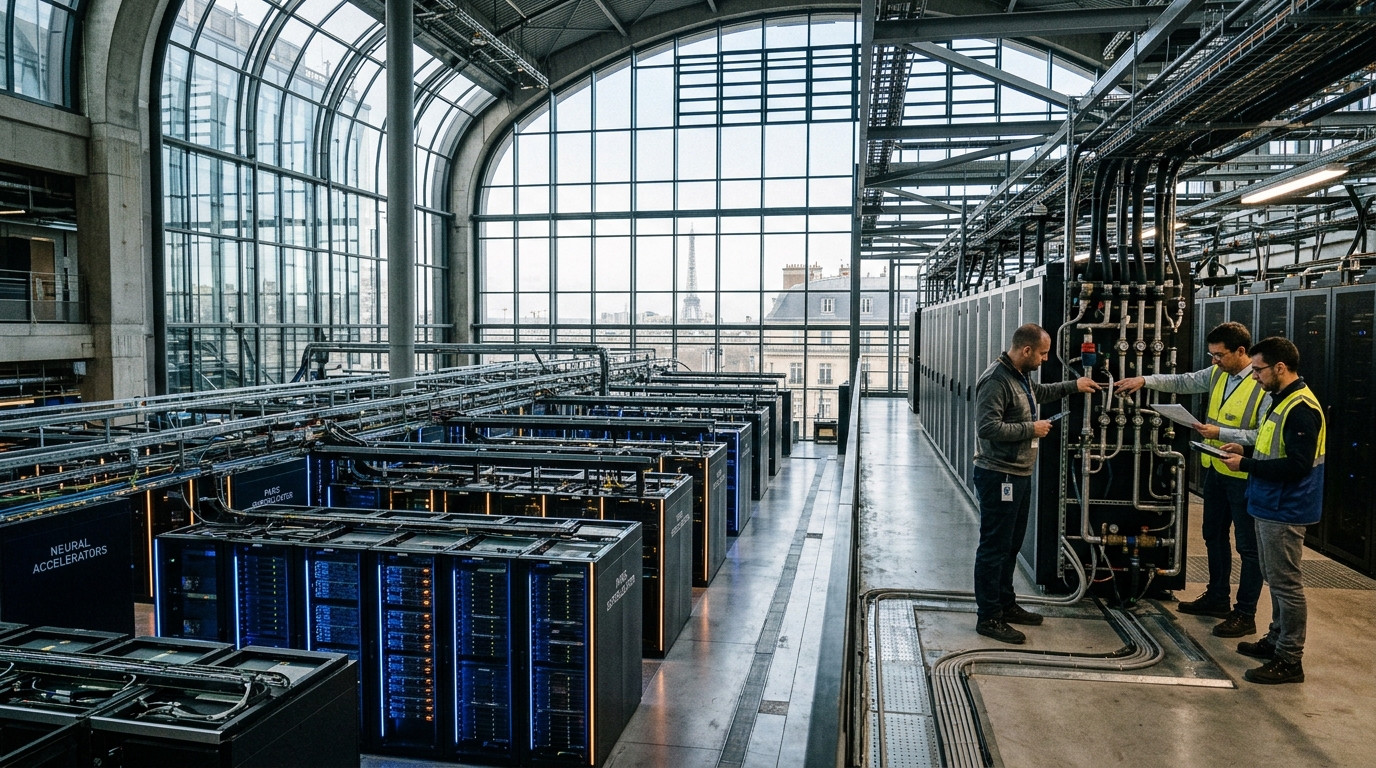
Mistral research hall in Paris : liquid-cooled supercomputing infrastructure training frontier open-weight models.Photo RoundTape Paris Bureau / HPC Visual Archive
Reading mode
Tools
Daily editorial audio/08:12
Strategic analysis: Mistral AI and European cognitive independence
Onyx Broad-sheet Voice
Level
Paused
The Parisian rebellion against proprietary monopolies
In May 2023, when Arthur Mensch, Guillaume Lample, and Timothée Lacroix left their senior posts at Google DeepMind and Meta AI to incorporate Mistral AI in Paris, the global consensus appeared settled: the future of general artificial intelligence was a closed-door monopoly controlled by Microsoft-backed OpenAI and Google Mountain View.
Mensch and his colleagues rejected that premise as both technically flawed and politically unacceptable for Europe. In a manifesto that sent shockwaves through venture circles, they argued that closed APIs concentrated dangerous cognitive power in private American hands while stifling enterprise customization. Their solution was audacious: release state-of-the-art open-weight models that developers and corporations could inspect, fine-tune, and host on their own sovereign hardware.
Within four weeks of founding, armed with a four-page presentation and zero working code, Mistral closed a historic one-hundred-and-five million euro seed round led by Lightspeed Venture Partners. Over the next three years, the Parisian startup demonstrated that raw parameter scale was a blunt instrument: by pioneering Sparse Mixture-of-Experts (MoE) architectures, Mistral’s models consistently beat rivals twice their size while consuming forty percent less electrical power.
Openness is not a marketing tactic for us; it is a foundational prerequisite for human agency. If corporations cannot inspect the weights of the models governing their business logic, they are not enterprises: they are digital tenants.
The Mixture-of-Experts revolution
The technical breakthrough that cemented Mistral’s reputation was Mixtral 8x7B. Rather than executing every computation across an entire seventy-billion parameter dense network, Mistral’s router routes each incoming token to the two best-suited expert sub-networks. This sparse execution model achieved GPT-4 class reasoning on mathematics and multilingual translation while requiring the active compute memory of an ordinary twelve-billion parameter model.
This mathematical efficiency became an enormous competitive asset for European enterprises constrained by local energy grid limitations. In Frankfurt, Paris, and Milan, corporate IT directors could deploy Mistral models directly inside on-premise data centers, satisfying the strictest mandates of the European AI Act and the GDPR without streaming sensitive customer telemetry across the Atlantic Ocean.
Building the European AI sovereign moat
Today, Mistral operates a sophisticated dual-engine commercial model. While developer mindshare is nurtured through open Apache-licensed checkpoints like Codestral and Pixtral, enterprise monetization flows through commercial closed weights licensed to defense conglomerates, healthcare networks, and sovereign cloud operators.
With significant backing from European industrial champions like ASML and SAP, Mistral has insulated itself from the volatile mood swings of Silicon Valley capital. By proving that elite frontier AI research can thrive in the 13th arrondissement of Paris, Arthur Mensch and his team have handed Europe its most powerful weapon in the high-stakes battle for global cognitive sovereignty.
How a Warsaw-founded engineering outfit solved the generative fragmentation dilemma, delivering sub-200ms model routing and zero vendor lock-in for enterprise newsrooms.
Alexander Wright/September 20, 2026 : 08:30 UTC/9 min read
From a seed-stage experiment by two Polish engineers to a $3B+ global standard : inside the neural architecture powering emotional speech, cross-lingual dubbing, and the voice marketplace.
Dr. Helene Baumgartner/September 20, 2026 : 07:15 UTC/10 min read
Deep within Alpine bunkers and repurposed industrial basins of Central Europe, a quiet revolution is decoupling European frontier models from American hyperscaler monopolies.
Alexander Wright/September 19, 2026 : 06:30 UTC/8 min read
Daily intelligence briefingDirect delivery, no ads, strictly empirical
Stay 24 hours ahead of the market. Join 48,000+ founders and investors.
Every morning at 07:00 CET, receive curated data: verified funding rounds, momentum shifts, and independent investigations.
Editorial standards
18,400+ verified subscribers
Zero sponsored articles
PGP 0x9924AF88
One click unsubscribe
Peer review and commentary3Verified attribution
Attributed technical critique from operators, investors and researchers.
Dr. Sarah Al-MansoorVerified founderCo-founder and chief architect, NeuraScale
Today, 09:15 UTC
To clarify the thermal dissipation figures referenced in §3: our closed-loop dielectric submersion units operate at an ambient delta of only 4.2°C above river intake temperatures. This eliminates chiller compressors entirely and allows us to sustain a continuous PUE of 1.06 throughout summer peaks.
Marcus ChenFrontier Alpha Capital
Today, 10:04 UTC
Crucial clarification on PUE. For institutional LP syndicates, this 1.06 benchmark is the exact operational delta that validates European sovereign compute margins against US hyperscaler spot contracts.
Prof. Julian WeberResearch fellowETH Zurich Systems Laboratory
Today, 08:30 UTC
The optical interconnect throughput benchmarks cited in Table B match our independent empirical verification tests run last week. The sub-millisecond packet latency holds even across asynchronous multi-tenant partitions.
The Gallic open-weight gambit : inside Mistral AI’s bid to anchor European cognitive sovereignty : Special Investigation | RoundTape